Understanding Anxiety: The Wisdom of the Internal Alarm

If you live with anxiety, your primary goal might be to get rid of it. It can feel like an intruder, a flaw, or a sign of weakness. However, when we look at anxiety through the lens of biology and evolution, we discover something different: anxiety is not a "glitch" in the system. It is a highly sophisticated, survival-driven alarm designed to keep you safe.
The Positive Intent of the Alarm
In evolutionary terms, our ancestors survived because they were anxious. Those who heard a rustle in the grass and assumed it was a predator survived to pass on their genes; those who assumed it was just the wind did not.
Anxiety is an expression of your brain’s deep commitment to your survival. It is an "early warning system" that sounds an alarm when it perceives a threat. The challenge in our modern world is that our brains often struggle to distinguish between a "sabre-toothed tiger" and a "difficult email from a manager". When the alarm is stuck in the "on" position, it becomes pervasive and overwhelming, affecting our daily quality of life.
What Happens When the Alarm Sounds?
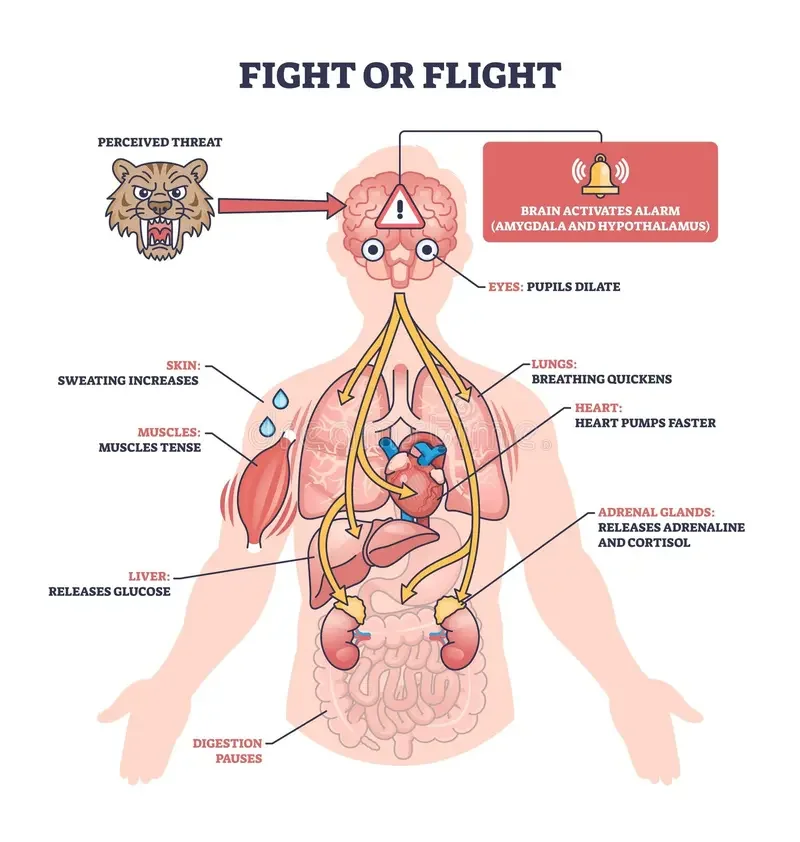
When your brain’s alarm system (the amygdala) perceives a threat—whether that threat is real or imaginary—it triggers a cascade of physiological changes almost instantly. This is the “Fight, Flight, or Freeze” threat response:
The Spike: Adrenaline and cortisol flood your system.
The Shift: Oxygen is diverted to your large muscles to prepare for action. This is why your heart races and your breathing becomes faster and shallow.
The Shutdown: Non-essential systems, like digestion and the “reasoning” part of your brain (the prefrontal cortex), are dialled down to maximise energy efficiency for survival.
This is why you cannot simply "reason" your way out of a panic attack or intense anxiety—the part of your brain responsible for logic has literally been taken "offline" to prioritise survival. This bodily response is quick, automatic, and unconscious; it kicks in before we’ve even had a chance to process what is happening. Anxiety, by its very nature, is meant to feel uncomfortable and intense because it is a survival mechanism working exactly as it should to help us escape a perceived threat.
Reframing the Sensation
Interestingly, the physiological "cocktail" of anxiety is remarkably similar to the sensations of excitement or focus. The butterflies you feel before a first date, the rush on a roller-coaster, or the "edge" you feel before an exam are all variations of this same arousal.
The sensation itself isn't "bad." It often signifies that something is important or meaningful to us. In the right context, it helps us to focus, stay alert, and think clearly. The problem arises when we judge the sensation as a sign of failure or danger. When we try to control or eliminate anxiety, or tell ourselves, "I shouldn't be feeling this", we add a layer of shame or fear to the original experience, creating a loop that is incredibly hard to break.
Changing the Relationship, Not the Experience
In therapy, the goal isn’t to "get rid" of anxiety. To do so would be to deny a vital part of your human experience. Instead, we work on changing your relationship with the alarm.
Through a combination of psychotherapy and hypnosis, we can learn to:
Acknowledge the alarm: "I can feel my heart racing. My system is trying to protect me."
Soothe the nervous system: Communicating safety back to the amygdala through somatic tools and deep focus.
Broaden the Perspective: Stepping back to see the anxiety from a distance, rather than being consumed by it.
When we stop fighting the sensation and start understanding its intent, we move from being 'victims' of our anxiety to being empowered observers of our own inner world. Like a lighthouse scanning the horizon, your anxiety is a guardian designed to keep you safe; it isn't the ‘storm' itself, but the signal that helps you navigate it. By learning to listen to the alarm without being consumed by it, we can reduce its impact on our lives and move forward with a greater sense of hope, purpose and peace.
Ready to change your relationship with anxiety?
Click on the button below to book your first session or a free 20 minute consultation to find out more.
