Courage is Fear Walking: Building Confidence Beyond Your Comfort Zone

We don't build confidence by staying still; we build it by moving through the 'wobble' of a new challenge.
Perhaps a lack of confidence is holding you back from feeling like yourself in social situations. Maybe it’s causing you to avoid an awkward but necessary conversation, or stopping you from stepping up at work.
When confidence is low, life can feel small. You might feel disempowered, stuck, or even isolated—as if everyone else has a secret code for confidence that you simply weren’t given.
But what if confidence isn't something you have, but something you build through the very feelings you might be trying to avoid?
The Goldilocks Zone: Comfort, Stretch and Panic
A common misconception is that confident people don’t feel fear, uncertainty, or vulnerability. In reality, confidence is born directly through these feelings (Smith, 2022). Luckner and Nadler’s (1991) Learning Model suggests that we exist in three distinct emotional zones. Understanding these can be incredibly helpful when we think about how we build confidence:
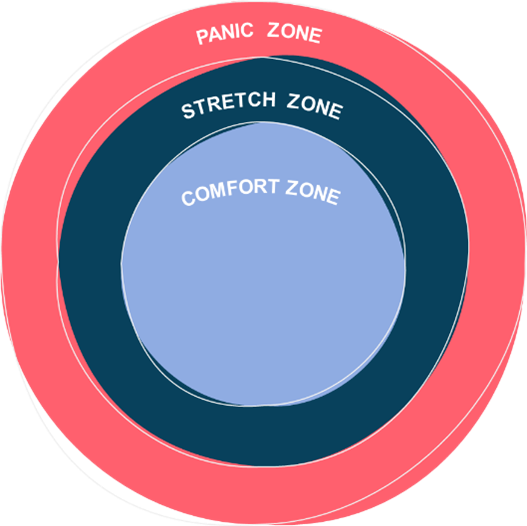
The Inner Comfort Zone: This feels safe, stable, and secure. While we all need rest here, staying too long can lead to boredom, listlessness and inertia. In this zone, we actually lose our courage to take risks and navigate through difficult emotions.
The Outer Panic Zone: This is the other extreme. Here, we feel overwhelmed, exhausted, and depleted. It is a landscape of high stress where learning and growth become nearly impossible because our survival brain has taken over.
The Middle Stretch (Growth) Zone: This is the "Goldilocks" zone for confidence. It’s where we feel anticipation, nervousness and a healthy level of challenge.
Building confidence requires us to "stretch" out of the easy and into manageable discomfort. It’s the feeling you had when you first learned to drive, ride a bike, start a new job, or become a parent. It wasn’t easy—there was likely frustration and disappointment—but the pride and confidence you felt afterward came because you moved through the challenge, not because it was necessarily easy.
Take a moment to note which areas of your life fit into which zone. Try to do this without adding analysis or judgment—just observe out of curiosity.
Courage: Fear Walking
Confidence isn't about eliminating fear, vulnerability, or awkwardness; it’s about changing your relationship with those feelings. It’s recognising that nervousness is often a sign that your body is gearing up to perform; it helps us stay alert and signals that what you are doing is meaningful.
“Courage is not the absence of fear; it is fear walking. It’s moving forward that matters.”
When we take fear with us into a new situation, we increase our resilience and our threshold for uncomfortable emotions. We send a powerful message to our nervous system: "I can sit with this discomfort and still function (and even possibly find enjoyment, pride, fulfilment)."
Practical Steps: Dipping Your Toe In
You don't have to leap into the deep end to build confidence. You can start by dipping your toe into the stretch zone with bite-sized, realistic challenges:
The Micro-Task: If a presentation feels like the "Panic Zone", try talking through it with a trusted friend first.
The Social Stretch: If a large gathering feels overwhelming, try simply saying hello to two people you pass on the street today.
The Brave Ask: Invite one friend for coffee as a stepping stone to a larger group event.
The Neutral Novelty: Take on a new hobby or activity unrelated to the specific area where you want more confidence.
Each time you step out and survive the discomfort, your brain begins to rewire (this is the beauty of neuroplasticity which you can read more about here). You are proving to yourself that you are capable of navigating the unknown.
How Therapy Helps
Building confidence can be lonely work, and it is often a battle with the "Inner Critic". In therapy, we can help you connect with those uncomfortable emotions with compassion rather than judgment.
Accepting the whole journey—the mistakes and the nerves included—makes them easier to navigate. Through our work together, you'll learn that true confidence doesn’t lie in your external accomplishments, but in how you view and respond to your own inner world.
Visualising Your Confident Self
Take a moment to consider what being confident means for you. You can do this exercise in a quiet moment with your eyes open or closed, talking out loud, or by writing—whatever helps you feel present and aware of your inner thoughts. Remember to accept whatever comes up without analysis or judgment.
Define the Feeling: What does feeling more confident look like to you? What do you want more of?
Identify a Model: Is there a version of yourself—or even someone you admire (real or fictional)—who embodies this? Was there a time in your life when you felt the confidence you’d like now? It doesn't have to be related to your current situation.
Visualise the Details: How do they/you carry themselves/yourself? How do they/you sound? What are they/you doing or wearing? How does their/your body feel as they/you respond to a challenge?
Apply the Vision: Now, think of the specific situation or area in your where you’d like to feel more confident and imagine it in the same amount of detail.
If it’s hard to see this clearly at first, that’s okay. Visualising the possibility of confidence is the first step toward inviting it in. There is no rush; each time you do this exercise, you can build on it.
Are you ready to move from the comfort zone to the growth zone? If you want to build your courage and move toward a life that feels bigger and brighter, I am here to support you.
Further Reading & References:
David, Susan. (2024) Redefining Bravery: Courage is Not the Absence of Fear. Available from: https://www.susandavid.com/newsletter/redefining-bravery-courage-is-not-the-absence-of-fear/ [Accessed 14/05/26]
Luckner, R. S., and Nadler, R.S. (1991) Processing the Adventure Experience: Theory and Practice. Dubuque: Kendall Hunt.
Salama, Rebecca. (2024) How Mindset Influences Pain. Available from: https://healthandwellbeingmagazine.org/how-mindset-influences-pain/ [Accessed 15/04/26]
Smith, Julie. (2022) Why Has Nobody Told Me This Before? London: Michael Joseph.
